
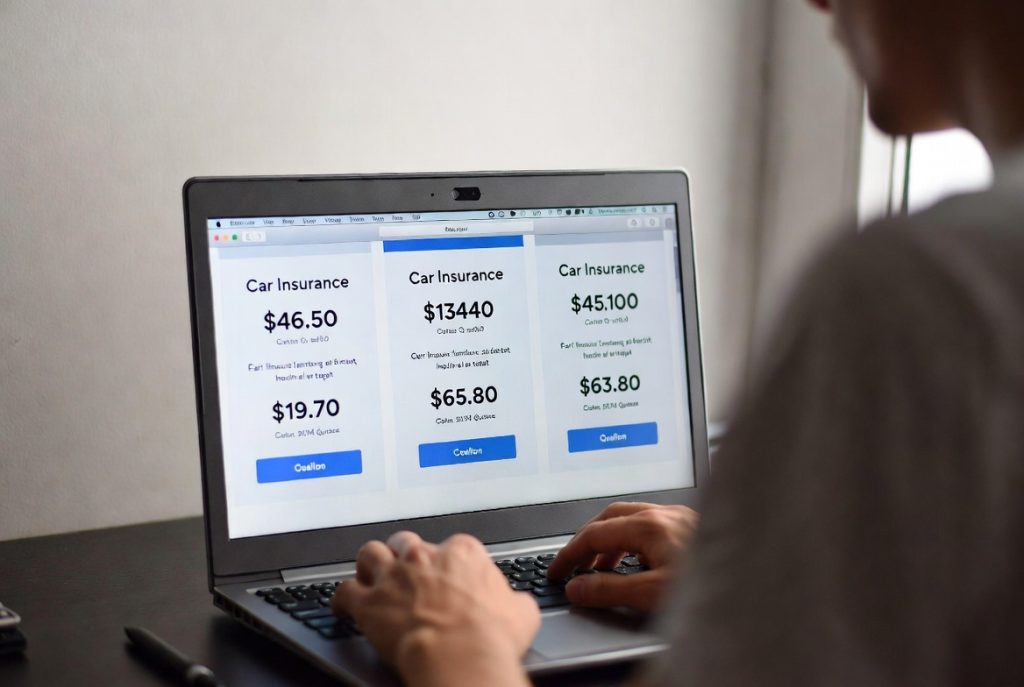
Three quotes is the right number. One isn’t enough — you have no reference point. Five gets overwhelming and the differences become noise. Three quotes, compared the right way, is the approach that finds real savings without wasting your afternoon.
The part most shoppers skip is the comparison itself. Getting quotes is easy. Making sure you’re comparing the same thing takes about ten minutes more — and that’s the part where the money is.
Make Sure the Coverages Match Exactly
This is the most common mistake. You get three quotes, see that one is $80 less per month, and feel great. Then you realize the cheaper one has half the liability coverage and a $2,000 deductible. That’s not a better deal — it’s a different product.
For a fair comparison, every quote needs identical:
- Liability limits — The standard shorthand is 100/300/100 (bodily injury per person / per accident / property damage). If one quote uses 50/100/50 and another uses 100/300/100, the premiums aren’t comparable.
- Uninsured/underinsured motorist coverage — Match these to your liability limits on every quote.
- Comprehensive and collision — Include or exclude them consistently across all three quotes. If you’re financing, you don’t have a choice — your lender requires them.
- Deductibles — More on this below, but pick one number and hold it constant across all quotes.
- Endorsements — Rental reimbursement, roadside, gap. Include or exclude consistently.
Before you request quotes, write down your chosen coverage structure on a piece of paper and give each agent or website the same inputs. Otherwise you’re comparing apples to different fruit.
Check the Deductibles
Deductible choice changes your premium more than almost any other single variable. The difference between a $500 deductible and a $1,000 deductible typically drops your collision premium by 15–30%.
That means a quote with a $1,000 deductible will look better than one with a $500 deductible — but you’ve traded the lower premium for higher out-of-pocket exposure if you file a claim. Neither is wrong. But you need to know which you’re looking at.
Normalize the deductibles when you compare. Pick $500 or $1,000 for both comprehensive and collision and get all three quotes at that number. Then decide separately whether to raise them to save money — that’s a second decision, not part of the comparison.
Look for Billing Fees
The premium isn’t the full cost. Billing structure adds up:
- Monthly installment fees — Many insurers charge $3–$10 per monthly payment. That’s $36–$120 a year on top of the stated premium.
- Paid-in-full discount — Paying six months or a year upfront often saves 5–10%. The quoted monthly premium usually doesn’t reflect this.
- Auto-pay discount — Setting up automatic payments eliminates many installment fees and sometimes earns an additional 1–3% discount.
- Electronic vs. paper billing — Some carriers charge $1–$2/month for paper statements.
When you get a monthly quote, ask: “What is the total six-month or twelve-month cost if I pay in full?” Then divide by the number of months. That’s the real monthly cost, not the installment number.
A Two-Page Comparison Sheet
Write this out or build a simple spreadsheet before you start. Columns: Carrier 1, Carrier 2, Carrier 3. Rows:
- Liability limits (must match)
- Uninsured/underinsured limits (must match)
- Comprehensive deductible (must match)
- Collision deductible (must match)
- Six-month premium — paid in full
- Six-month premium — monthly installments (include all fees)
- Any additional endorsements included or excluded
- AM Best rating (financial strength — aim for A or better)
- J.D. Power claims satisfaction score (optional but useful)
The winner is the carrier with the lowest total six-month cost at the same coverage level, from a company rated A or better for financial strength. That’s the number that matters.
Next step: Write down your desired coverage structure — liability limits, deductibles, and endorsements — before you request your first quote. Get a same-day quote that works for your situation →
Last modified: May 10, 2026
About the Author: Casey Rivera