
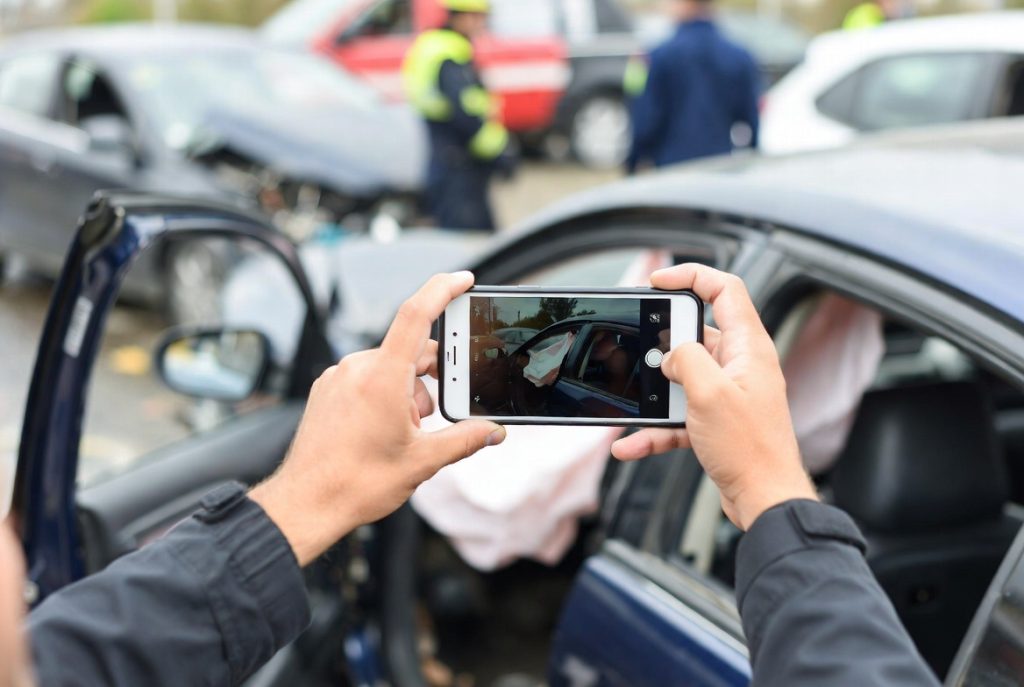
A good claim almost always starts with a great set of photos. Here’s the list — twelve shots, in order, in five minutes. You don’t need to be a photographer. You need to be systematic.
The Twelve Shots
Take these in order, starting immediately after ensuring everyone is safe. Don’t wait for police to arrive — document the scene as it is right now.
- Wide shot of the full scene. Stand back far enough to capture both vehicles, the road, and any nearby intersections or signs. This establishes context — where the accident happened and what the environment looked like.
- Second wide shot from the opposite angle. Walk to the other side and shoot again. Two wide shots cover what a single angle misses.
- Your vehicle — front. Full front of your car, even if that side isn’t damaged.
- Your vehicle — rear. Full rear, same logic.
- Your vehicle — both sides. Left side, then right side. Capture the full length.
- Close-up of your vehicle’s damage. Get as close as necessary to show paint transfer, dents, cracks, or deformation clearly. Take multiple close-ups from different angles.
- Other vehicle — same full-coverage sequence. Front, rear, left side, right side, close-up of their damage. You want their damage documented even if you’re not at fault — especially if they try to claim additional damage later.
- Paint transfer. If their paint is on your car or vice versa, photograph it before it gets wiped away. This connects the two vehicles at the scene.
- Skid marks or debris. Skid marks show speed and braking behavior. Debris field shows the point of impact. Both matter for fault determination.
- Traffic controls visible. Photograph any stop signs, traffic lights, yield signs, or road markings in the frame. If there’s a dispute about who had the right of way, these photos are your evidence.
- All license plates. Both vehicles. Clear and readable. If the other driver leaves before police arrive, you have their plate documented.
- The other driver’s insurance card. Ask them to hold it up and photograph it directly. This captures carrier name, policy number, and expiration date without transcription errors.
How to Capture VINs and Plates
A VIN (vehicle identification number) is a 17-character code that uniquely identifies a vehicle. You’ll need it for your claim and to run a vehicle history check. There are two places to find it:
- Dashboard plate: Visible through the lower left corner of the windshield from outside the car. This is the easiest to photograph.
- Door jamb sticker: On the driver’s side door frame. Contains VIN plus tire pressure, paint code, and manufacturing info.
Photograph both. For the other vehicle, photograph the dashboard plate through the windshield — you don’t need access to the interior.
License plates should be shot straight-on from 2–3 feet away. Make sure the text is fully readable and not obscured by a sun angle or shadow.
When Video Helps More Than Photos
Video captures things a still photo can’t — ongoing hazards, the position of vehicles over time, audio of what the other driver says at the scene.
Use video when:
- The scene is complex and a single-frame shot won’t show spatial relationships clearly
- There are ongoing hazards (traffic, fluids, downed wires) that need to be documented
- You want to narrate what you’re seeing while it’s fresh (“This is the north side of the intersection, the traffic light is currently green…”)
- The other driver is making statements that contradict what happened — a continuous video catches that
A 60-second walkthrough video of the full scene, shot in addition to still photos, gives your adjuster a complete picture. It takes one extra minute.
A Pocket Reference
Save this to your phone’s photos or print and keep in your glove box:
- Wide scene x2 (from opposite angles)
- Your car: front, rear, both sides, damage close-ups
- Their car: front, rear, both sides, damage close-ups
- Paint transfer on both vehicles
- Skid marks and debris
- Traffic signs and signals
- Both license plates
- Their insurance card
- VIN: dashboard plate + door jamb on both vehicles
- 60-second video walkthrough
Next step: Screenshot this article and save it to your phone’s camera roll right now — you’ll thank yourself at the scene. Get a same-day quote that works for your situation →
Last modified: April 18, 2026
About the Author: Casey Rivera