
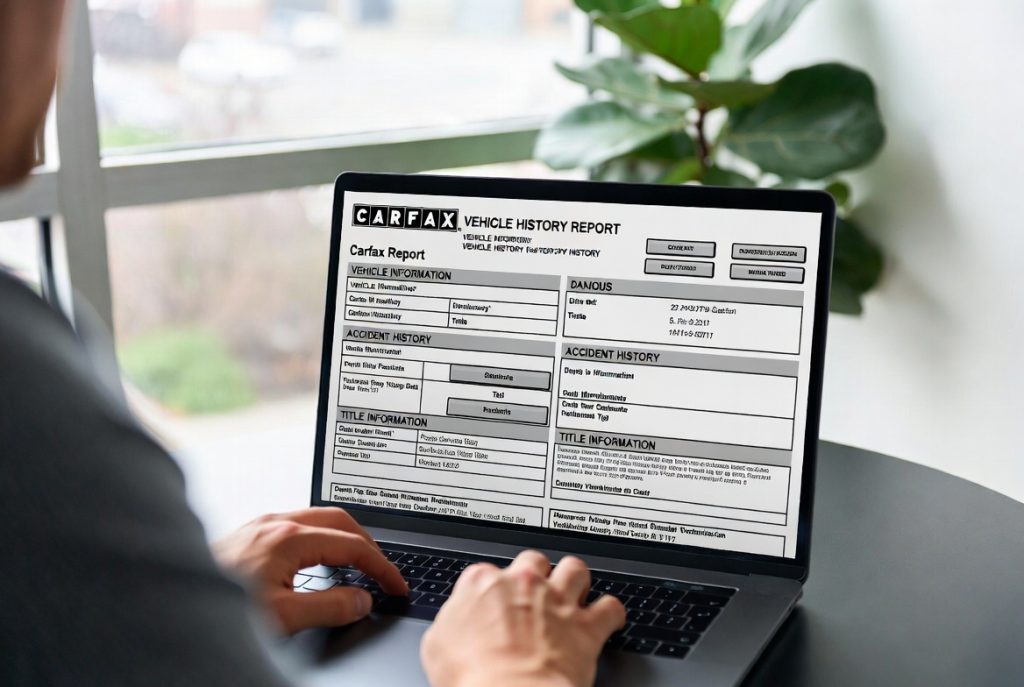
A vehicle history report is mostly noise — pages of oil changes, registration renewals, and mileage readings that don’t tell you much. Except for four or five lines that matter a lot. Knowing where to look saves you a thousand-dollar mistake before you hand over a check.
The Five Lines That Actually Matter
When you open a Carfax or AutoCheck report, scroll past the service records and look for these five data points:
- Title brands — Any label applied to the title by a state DMV. Salvage, flood, lemon, rebuilt, junk. These are non-negotiable red flags. More on each below.
- Accident records — Reported crashes, usually from insurance companies, police reports, or repair shops. Note severity: “minor damage” vs. “airbag deployment” are very different things.
- Number of owners — One or two is normal. Four owners in five years is a signal worth asking about.
- Odometer rollback flags — The report will flag if reported mileage ever decreased or jumped oddly. That’s fraud.
- Lien or loan activity — An open lien means the seller may still owe money on the car. That becomes your problem if you buy it.
Title Issues — What to Flag
Title brands follow a vehicle forever. Here’s what each one means:
- Salvage — The car was declared a total loss by an insurer. Structural damage was severe enough that repair cost exceeded ACV (actual cash value). Drive it cautiously; financing is harder, insurance is limited.
- Rebuilt / Reconstructed — A salvage vehicle that was repaired and reinspected. It can be legally driven, but some insurers won’t write full coverage on it.
- Flood — Water damage, typically from storm surge or submersion. Corrosion is unpredictable and often invisible at point of sale.
- Lemon — The manufacturer repurchased the vehicle under a state lemon law. This means it had a serious, recurring defect that couldn’t be fixed.
- Junk / Scrapped — Declared unfit for road use. If one of these is on the road, something went wrong upstream.
Title laundering happens. A flood vehicle totaled in Louisiana can get a clean title in Montana after being repaired and sold across state lines. The NMVTIS database (free at vehiclehistory.gov) pulls data from all 50 states and is sometimes more current than Carfax or AutoCheck for this exact issue.
Service Records vs. Accidents
Service records tell you the car was maintained. Regular oil changes, brake jobs, and tire rotations are good signs. But service records are self-reported — a careful owner gets them; a neglectful one doesn’t. Absence of records doesn’t always mean neglect, especially on older private-party vehicles.
Accidents are a different story. Look at the gap between the accident date and the next service entry. A car that sat for six months after a reported crash before showing up at a dealer deserves a closer look.
Watch for accidents with no repair records following them. Either the repair was done off-book, or the damage wasn’t fixed. A pre-purchase inspection by an independent mechanic ($100–$150) tells you what the history report can’t.
A 10-Minute Read
Here’s a fast workflow that covers the important ground:
- Open the report. Jump to the title history section first.
- Check for any title brand. If there’s one, decide whether you’re comfortable with it before reading anything else.
- Count the owners and check state history. Multi-state history in short windows can signal title laundering.
- Look at the accident section. Note dates, severity, and what damage was reported.
- Scan odometer readings for any drop or suspicious jump.
- Check for an open lien. If one exists, get it in writing that it will be paid off at closing.
Which report to use? Carfax is the most widely recognized. AutoCheck covers some auctions Carfax doesn’t. NMVTIS (vehiclehistory.gov) is free and government-maintained. The most thorough approach is to run all three — but at minimum, run Carfax or AutoCheck plus a free NMVTIS check.
Next step: Before you test-drive any used vehicle, pull its NMVTIS report free at vehiclehistory.gov and note the VIN for a full Carfax. Get a same-day quote that works for your situation →
Last modified: April 25, 2026
About the Author: Casey Rivera